
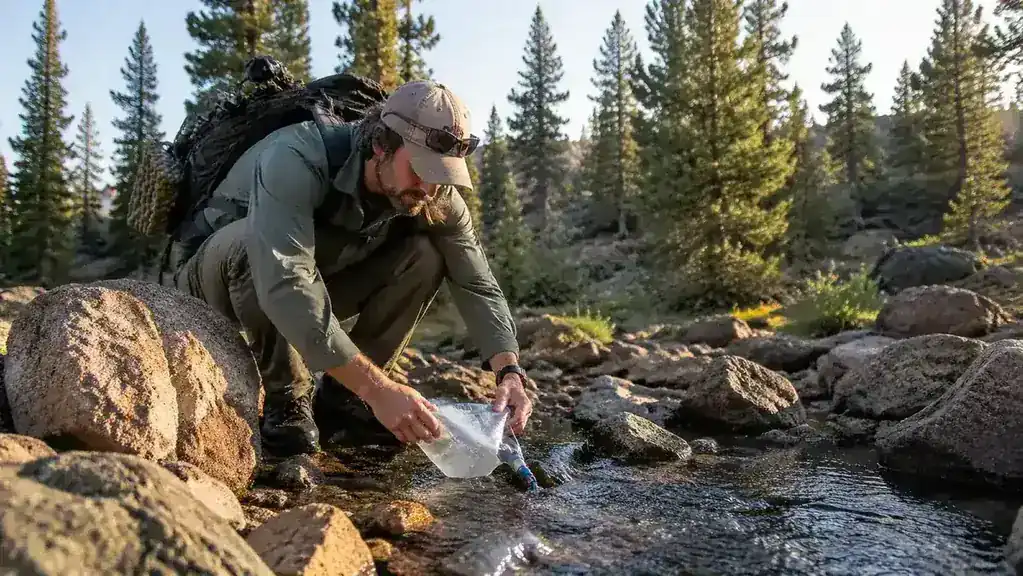
I got sick from backcountry water exactly once. It was 2019, the Enchantments, a glacial tarn that looked about as pristine as water gets. I was two days in and running low on fuel, so I skipped filtering and drank straight from the source. Four days later I was in urgent care with textbook Giardia symptoms. The doctor told me the cysts can survive in near-freezing water for months. Clear water and high elevation do not mean safe water. That was the last time I skipped the filter.
The Sawyer Mini is what I carry now, and it is what I recommend to anyone who asks. It weighs 2 ounces, filters down to 0.1 microns, and handles bacteria and protozoa including Giardia and Cryptosporidium. It does not filter viruses, which I will cover later and which matters more in some destinations than others. But for the vast majority of backcountry trips in North America, a 0.1-micron hollow-fiber filter is the right tool. The Sawyer Mini has earned 4.7 stars across more than 41,000 reviews on Amazon. That is not a small sample size.
Giardia is in streams that look clean. The Sawyer Mini weighs 2 oz and filters 100,000 gallons.
The filter I carry on every trip. Check today's price and shipping options below.
Amazon Check Today's Price on Amazon →Step 1: Understand What You Are Filtering and What You Are Not
Most backcountry illness in North America comes from protozoa (Giardia, Cryptosporidium) and bacteria (E. coli, Salmonella, Campylobacter). A 0.1-micron hollow-fiber filter like the Sawyer Mini removes both categories reliably. Giardia cysts are 8-12 microns. Cryptosporidium oocysts are 4-6 microns. Bacteria range from 0.2 to 10 microns. All of those are caught by a 0.1-micron filter.
Viruses are a different story. Norovirus and hepatitis A are 0.02-0.1 microns, too small for a fiber filter to catch. In backcountry North America, viral contamination in surface water is uncommon because the main source is human fecal matter at scale, and the populations are low. But if you are hiking in heavily used areas, paddling near agricultural runoff, or traveling internationally, add a chemical step. Aquatabs or Katadyn Micropur tablets take care of viruses and cost almost nothing per trip. Carry a handful as backup regardless.
Sediment is not a biological threat but it clogs your filter fast. Silty glacial runoff and desert mudhole water will reduce flow rate significantly and shorten the working life of any hollow-fiber filter. Pre-filtering through a bandana or coffee filter removes the bulk of suspended particles before you run water through the Sawyer Mini. That one habit will keep your filter flowing for years instead of months.
Step 2: Choose Your Water Source Carefully
Not all surface water is equal even before you filter it. Moving water is generally better than standing water. Water far from trails, campsites, and grazing land is better than water near them. The goal is to start with the cleanest source available so the filter has less work to do and so your chemical backup (if needed) has fewer competing organic compounds to fight.
When you reach a stream or lake, look upstream before you fill. Check for obvious contamination: dead animals in or near the water, heavy algae blooms, discoloration, or strong odor. Algae blooms in late summer can produce cyanotoxins that no filter removes. If the water smells wrong or looks actively green and foamy, find a different source. Most backcountry water in healthy forest or alpine ecosystems will look fine and smell like nothing.
At a stream, collect from the mid-channel at depth, not from the bank where sediment and organic debris concentrate. At a lake, wade in a few steps and collect from below the surface film. Keep your dirty water bag and your clean water bag physically separated, ideally different colors or clearly labeled. Contaminating your clean bag with dirty water is a common and entirely avoidable mistake.
Step 3: Set Up the Sawyer Mini Correctly
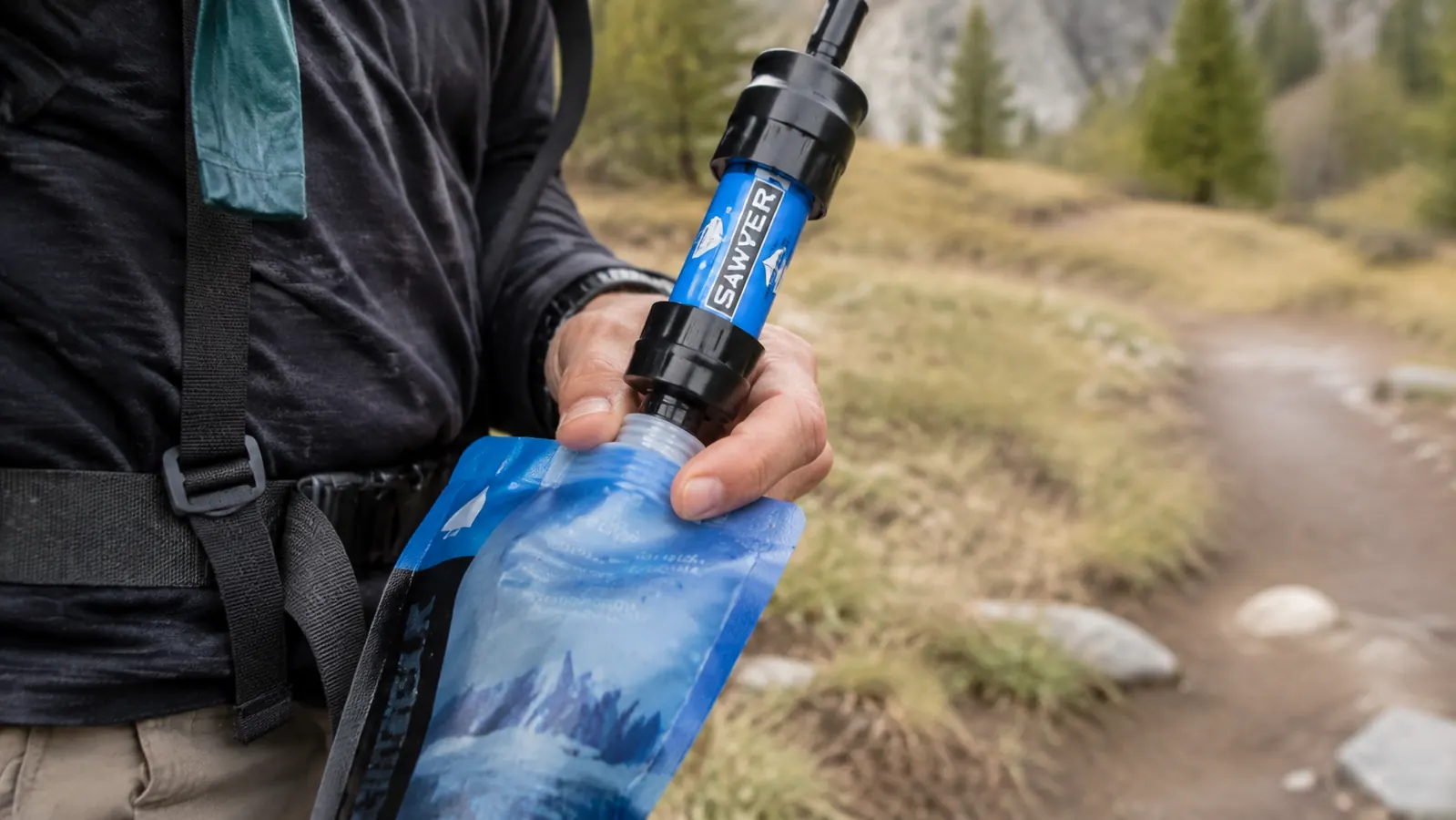
The Sawyer Mini ships with a 16-oz squeeze pouch, a cleaning syringe, a straw adapter, and a thread adapter for hydration bladder hoses. Each has its use, but the core system is simple: fill the squeeze pouch with dirty water, screw the filter onto the pouch threads, and squeeze filtered water into your clean container or directly into your mouth.
The threading is standard 28mm, the same as a standard plastic water bottle. A Smart Water 1-liter bottle fits perfectly and is considerably more durable than the included pouch. Many experienced backpackers use two Smart Water bottles: one dirty, one clean, with the Sawyer Mini threading between them. Fill the dirty bottle at the source, screw on the filter, invert, and squeeze into the clean bottle. It is fast, reliable, and the setup weighs about 4 ounces total.
If you are using a hydration bladder, the thread adapter lets you attach the Sawyer Mini inline so water filters on the way to the bite valve. The flow rate is slower than gravity filtering but you do not have to stop and squeeze. For long water carries where you want filtered water available while you walk, this setup is genuinely useful.
Step 4: Filter Your Water
Fill your dirty pouch or bottle from the source. Screw the Sawyer Mini onto the threads. If filtering into a separate container, hold the filter over the opening and squeeze steadily. Do not jerk or force it. The hollow fibers inside are durable but they can be damaged by sudden pressure spikes, which is especially true in cold conditions when the plastic becomes stiffer.
Flow rate on a new Sawyer Mini is about 34 ounces per minute under normal squeeze pressure. A liter takes roughly 30-40 seconds when the filter is new. As sediment accumulates in the fibers over miles of use, flow rate drops. When you notice it taking significantly longer, that is your signal to backflush (Step 5). A properly maintained Sawyer Mini should flow nearly as fast after backflushing as it did new.
In a group, the Sawyer Mini can keep up with two or three people filtering in rotation if you are not all filling simultaneously. For larger groups or high-mileage thru-hikers filling multiple liters at once, consider a gravity filter setup: hang the dirty bag high, run a hose through the Sawyer Mini, and let gravity push water into the clean bag below. It is slower per minute but completely hands-free and can fill a 2-liter bag while you set up camp.
A new Sawyer Mini filters a liter in about 35 seconds. If it takes three minutes, it needs backflushing. If backflushing does not restore flow, the filter is done.
Step 5: Backflush to Maintain Flow Rate
Backflushing is the single maintenance step most people skip and the main reason filters slow down and eventually fail. The process takes two minutes and should happen any time you notice a significant drop in flow rate, at the end of every multi-day trip, and before storing the filter at home.
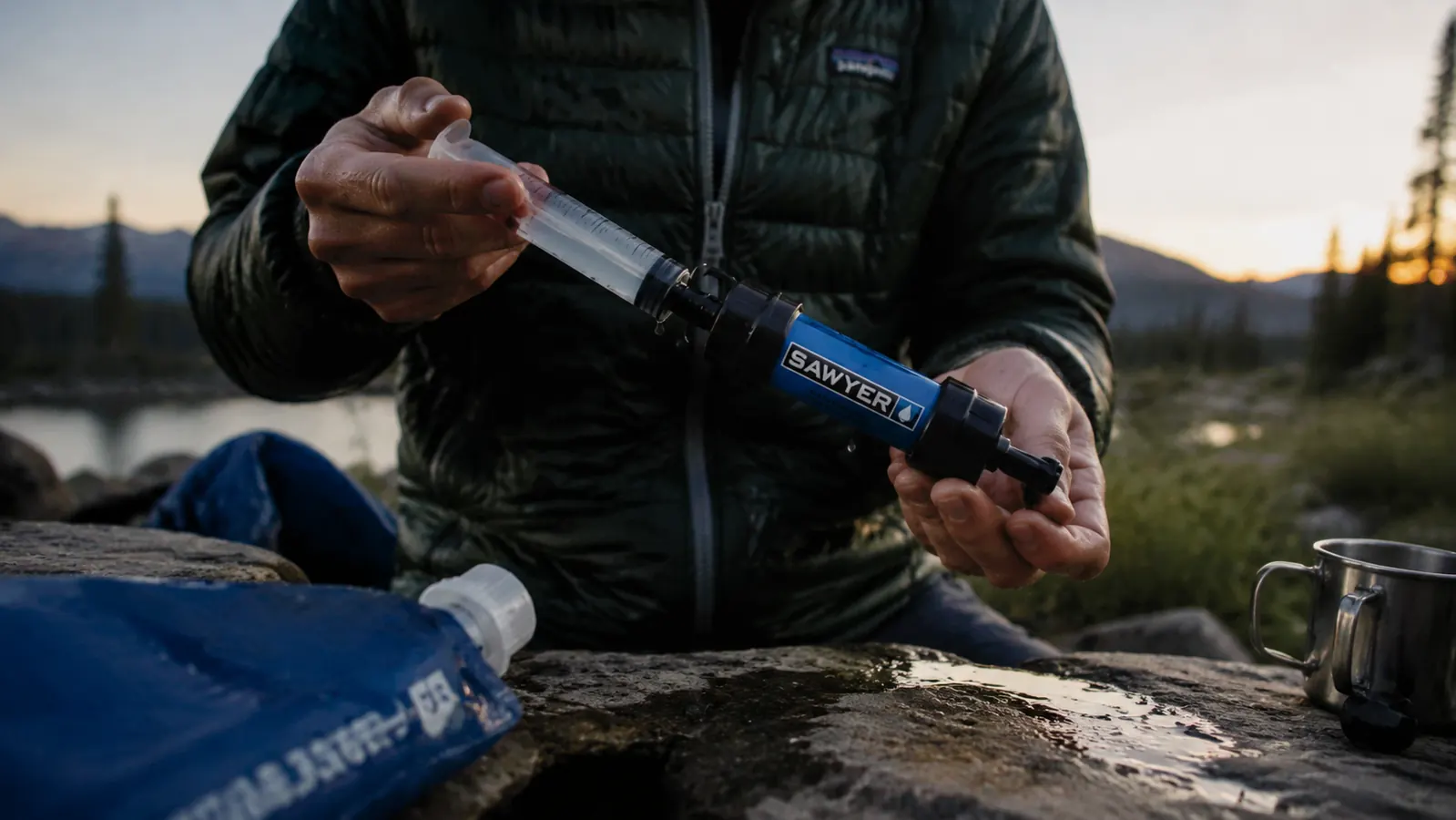
Fill the included cleaning syringe with clean, already-filtered water. Attach it to the output end of the filter (the end water exits from when you use it normally). Push the plunger firmly to force clean water backward through the hollow fibers and out the input end. Murky water will often come out on the first few pushes, clearing as you continue. Repeat until the water running through looks clear. That is it. The filter is restored.
The most important rule about storing the Sawyer Mini: never let it freeze while wet. Ice crystals forming inside the hollow fibers will rupture them. The damage is invisible from the outside but the filter will pass contaminated water without any indication that it has failed. If you are backpacking in temperatures that dip below freezing, keep the filter in your sleeping bag overnight. If you suspect the filter has frozen while wet, retire it immediately.
What Else Helps
The Sawyer Mini handles 99.99999% of bacteria and 99.9999% of protozoa. That covers almost everything you will encounter on most North American trips. But a few additions round out a complete water treatment system without adding meaningful weight.
Aquatabs or Micropur tablets add virus coverage and cost less than a dollar per treatment. I carry four or five per trip and use them when the source looks questionable or when I am near a heavy-use area. They add 30 minutes of wait time, so I treat water at camp while setting up and it is ready before dinner. Activated carbon pre-filters (some filters include these inline) improve taste from algae-heavy water but are not needed for safety. If taste is not an issue, skip the weight.
A pre-filter bandana or a spare sock folded several times removes visible sediment before it hits the fiber filter. I use an old buff folded four times. It has extended the useful life of my current filter noticeably. On desert trips where water sources are silty pools or cattle tanks, I carry a small stuff-sack mesh bag to let sediment settle for five minutes before filling the dirty bag.
For more on where the Sawyer Mini fits in a complete water system versus other options, check the long-term review of the Sawyer Mini and the rundown of 10 reasons the Sawyer Mini belongs in every pack.
Two ounces. 100,000-gallon rated lifespan. The filter that fits any water bottle thread.
The Sawyer Mini is rated 4.7 stars across 41,000+ reviews. Check today's price and what's currently in stock.
Amazon Check Today's Price on Amazon →